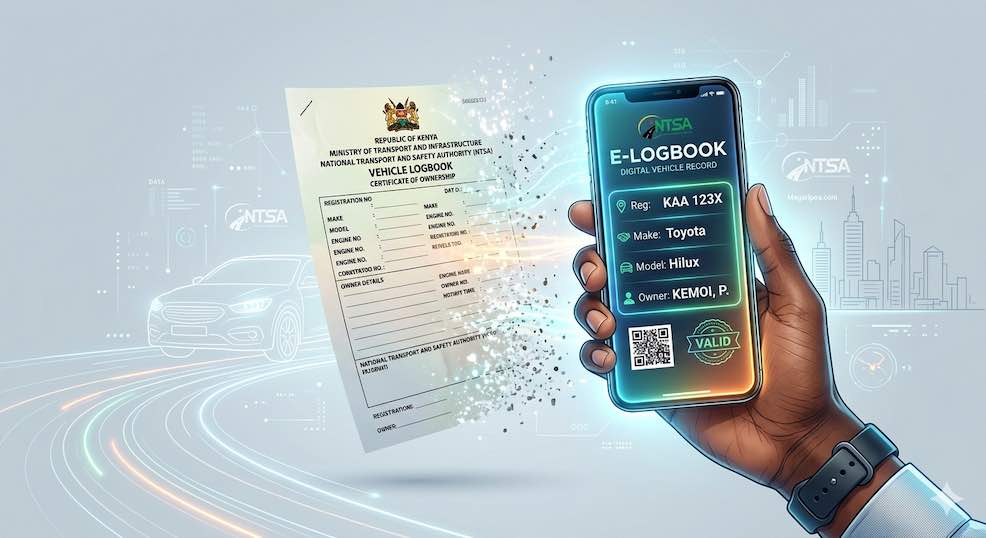
On June 10, 2026, Kenya's transport sector will undergo one of its most significant transformations in decades. The National Transport and Safety Authority (NTSA) will officially phase out traditional paper logbooks, replacing them with fully digital e-Logbooks accessible through the eCitizen platform. For Kenya's estimated 4 million vehicle owners, this marks the end of an era and the beginning of a new digital chapter in vehicle ownership.
What NTSA Has Said
NTSA Director General Nashon Kondiwa announced the rollout during a media briefing at the third Annual Regulatory Authorities and Agencies Conference at South Eastern Kenya University on May 7, 2026, stating that the authority is bringing services closer to citizens while eliminating bureaucracy and cartels.
The transition represents a fundamental shift in how Kenyans will prove vehicle ownership, transfer vehicles, and interact with financial institutions for vehicle financing. Vehicle ownership records will be generated instantly through the NTSA portal once the e-Logbook system goes live, with automated processes via the eCitizen platform replacing manual, paper-based motor vehicle registration.
How the E-Logbook System Will Work
Instant Digital Generation
Unlike the current system where motorists wait days or weeks for physical logbooks to be printed and delivered, e-Logbooks will be generated instantly through the NTSA portal, allowing vehicle ownership and registration details to be updated in real time.
When you register a new vehicle or complete an ownership transfer, the digital logbook will appear immediately in your eCitizen account. There will be no more queuing at NTSA offices, no more courier deliveries, and no more anxious waiting to receive your vehicle's registration certificate.
Advanced Security Features
The e-Logbooks will use digital encryption and secure hashing technology to reduce cases of forgery and fraudulent ownership documents that have long affected the transport sector. This represents a significant upgrade from paper logbooks, which have been vulnerable to sophisticated forgery operations.
Each logbook will feature advanced security measures, including encryption and secure hashing, with a QR code that buyers, banks, and insurers can scan to verify ownership and details instantly. This QR code will serve as a quick verification tool, allowing anyone with legitimate interest to confirm a vehicle's ownership status and history in seconds.
Online Vehicle Transfers
One of the most transformative features is the ability to complete vehicle transfers entirely online. Vehicle buyers and sellers will be able to initiate ownership transfers online without visiting NTSA offices. This eliminates one of the most frustrating aspects of buying or selling a used vehicle in Kenya—the time-consuming visits to NTSA offices, often involving long queues and multiple trips.
The online transfer process will update ownership records instantaneously once both parties complete the required steps and payments through the eCitizen platform. The new system will enable vehicle sellers and buyers to initiate transfers online without visiting NTSA offices.
No More Replacement Costs
Lost or damaged physical logbooks currently require motorists to pay replacement fees, file police reports, and wait for new documents to be processed. NTSA has termed the e-logbooks as efficient due to low risks of loss and low replacement costs.
With digital logbooks, if you need a copy, you simply log into your eCitizen account and download it. There are no replacement fees, no police abstracts required, and no waiting period. This alone could save Kenyan motorists thousands of shillings annually in replacement costs and related expenses.
The Problem E-Logbooks Aim to Solve
The Scale of Logbook Fraud in Kenya
To understand why NTSA is making this dramatic shift, we must examine the extent of logbook fraud that has plagued Kenya's transport sector for years. The statistics paint a troubling picture.
A gang of 10 fraudsters managed to hack the NTSA system and used information on car logbooks to swindle insurers out of millions of shillings, with the conmen using details of one car to generate fake logbooks for non-existent vehicles.
The fraud schemes have been sophisticated and costly. In one case, a fraudster obtained over Sh4.4 million through forged logbooks of four vehicles belonging to unsuspecting vehicle owners, working with crooked NTSA officials at the ICT department to be registered in the TIMS system as the bonafide owner of vehicles.
The human cost has been devastating. Vehicle owners were left at the mercy of ruthless auctioneers who went for the vehicles that had been used as security to finance fraudsters' lifestyles. Legitimate vehicle owners have found themselves facing loan recovery actions for debts they never incurred, with their vehicles at risk of repossession.
How the Fraud Schemes Operated
The fraud cartels developed an organized system that exploited weaknesses in the paper-based logbook system. Fraudsters would identify a vehicle on the road or at a parking slot, then contact their partners in crime at the NTSA and have the vehicle registered in their names before rushing to micro-finance institutions to obtain credit.
These schemes often involved insiders at multiple institutions. Crooked NTSA officials would manipulate the Transport Integrated Management System (TIMS) to register vehicles to fraudsters, who would then use the forged documents to secure loans from unsuspecting financial institutions. By the time the fraud was discovered, the money had disappeared and the legitimate vehicle owner faced financial ruin.
NTSA Director General Nashon Kondiwa stated that the shift targets cartels that have thrived within manual processes. The e-Logbook system aims to eliminate these vulnerabilities by creating an tamper-proof digital trail of ownership that cannot be manipulated by insiders.
Benefits for Different Stakeholders
For Vehicle Owners
Convenience: Access your logbook anytime, anywhere through your phone or computer. No more keeping physical documents safe or carrying them during vehicle inspections.
Cost savings: Vehicle owners will no longer incur replacement charges for lost logbooks, as copies can be downloaded directly from their eCitizen accounts at no cost.
Automated reminders: Motorists will receive automated reminders for renewals, helping them stay compliant with insurance, inspection, and licensing requirements.
Faster transactions: Whether selling your vehicle or using it as collateral for a loan, the instant verification will speed up processes that currently take days or weeks.
For Financial Institutions
The NTSA system allows banks and SACCOs to directly verify ownership and lien status, eliminating the need for physical file copies and expediting loan approvals for vehicle financing.
This real-time verification addresses a major pain point in vehicle financing. Currently, banks must physically verify logbooks, check for existing liens, and worry about forgeries. The digital system provides instant, authoritative verification that cannot be faked, significantly reducing the risk of lending against fraudulent documents.
For the financial sector, the eLogbook is expected to streamline vehicle financing processes by enabling banks and Saccos to digitally verify ownership and lien status without relying on physical files, with lenders also able to register and discharge financial interests electronically.
For Law Enforcement
Police and inspection units can query the e-logbook database live to confirm ownership, stolen status, insurance validity, and inspection history, which improves compliance checks and recovery of stolen vehicles.
Traffic officers conducting roadside inspections will no longer need to examine physical documents that could be forged. A quick database query will instantly reveal whether a vehicle is properly registered, insured, compliant with inspection requirements, and not reported stolen.
This real-time access should significantly improve law enforcement's ability to identify stolen vehicles, uninsured drivers, and vehicles operating with fraudulent documentation.
For Car Buyers
Used car buyers face significant risks in Kenya's current system. Forged logbooks, vehicles with hidden liens, and ownership disputes are common problems. Each logbook will include a QR code that buyers can scan to verify ownership and details instantly.
Before handing over payment, a buyer can scan the QR code and immediately see the vehicle's complete ownership history, any registered liens, whether it has been reported stolen, and its inspection status. This transparency should reduce the fraud that currently plagues the used car market.
The Technology Behind E-Logbooks
Built on Existing Infrastructure
The Transport Integrated Management System (TIMS) launched in 2016 with World Bank funding under the Eastern Africa Regional Transport, Trade and Development Facilitation Project, cutting some processing times from months to days.
The e-Logbook system builds on this foundation, representing the final piece of NTSA's digital transformation. The TIMS, funded under the World Bank-supported Eastern Africa Regional Transport, Trade and Development Facilitation Project, simplified the application, processing, and issuance of driving licenses.
The system has already proven successful with digital driving licenses, demonstrating that NTSA can handle large-scale digital transformation. The e-Logbook rollout benefits from lessons learned during previous digitization efforts.
Security Architecture
The e-Logbook system will enable NTSA to shift from a reactive, paper-based registry that is prone to fraud, delays, and errors to a proactive, real-time digital system with strong integrity controls and automated lifecycle management.
The encryption and secure hashing technologies protect data integrity, ensuring that records cannot be tampered with once created. Digital signatures verify authenticity, and audit trails track every change to ownership records, creating accountability that was impossible with paper documents.
Integration with Other Systems
The e-Logbook system will integrate directly with insurance providers, vehicle inspection units, and law enforcement databases. This interconnected ecosystem means that when you update one element—such as renewing insurance—the change reflects immediately across all connected systems.
For motorists, this integration means fewer separate processes to manage. For authorities, it creates a comprehensive view of vehicle compliance status that supports better enforcement and road safety.
Implementation Timeline and Transition Process
The June 10, 2026 Launch Date
The e-logbook system is set to go live on Wednesday, June 10, 2026. On this date, NTSA will begin issuing only digital logbooks for new registrations and transfers.
What Happens to Existing Physical Logbooks?
The announcement has not provided complete clarity on how existing physical logbooks will be handled. Critical questions remain:
- Will current logbook holders need to actively migrate their documents to the digital system?
- Will NTSA automatically port existing records to the e-Logbook database?
- Can motorists continue using physical logbooks for some transition period, or will June 10 mark a hard cutoff?
- What is the process and cost, if any, for converting an existing physical logbook to a digital one?
NTSA Corporate Communication Principal Officer Anthony Nyongesa said the authority had put support systems in place for motorists, with those seeking clarification or assistance able to contact NTSA through official communication channels.
Motorists should expect NTSA to provide detailed guidance on the migration process in the coming weeks. It would be prudent to check the NTSA website and eCitizen platform regularly for updates as the launch date approaches.
Support Systems Being Established
NTSA said training programmes and help desks would be set up to assist motorists and stakeholders adapt to the new platform.
NTSA has assured stakeholders that support systems and training programmes will be put in place ahead of the rollout to ensure a smooth transition to the new digital platform.
These support mechanisms will be crucial, particularly for motorists in rural areas or those less familiar with digital platforms. NTSA's success in implementing this transition will largely depend on how effectively these support systems function.
Potential Challenges and Concerns
Digital Literacy and Access
Not all Kenyan motorists are comfortable with digital platforms. While eCitizen has become increasingly familiar to Kenyans over the past few years, significant portions of the population, particularly older motorists and those in rural areas, may struggle with the transition.
Internet connectivity remains inconsistent across Kenya. While Nairobi and major urban centers have reliable connectivity, rural areas often face connectivity challenges that could make accessing digital logbooks difficult.
The success of e-Logbooks will depend partly on NTSA's ability to provide accessible support for less tech-savvy users and ensure the system works even in areas with limited internet access.
Data Privacy and Security
Centralizing all vehicle ownership data in a single digital system raises legitimate privacy and security concerns. Who will have access to query the database? Under what circumstances? What safeguards prevent abuse of this data?
The system will link vehicle ownership to national ID numbers, creating a comprehensive database of who owns what vehicles in Kenya. While this supports fraud prevention, it also creates privacy implications that warrant careful oversight.
NTSA must ensure robust cybersecurity measures to prevent data breaches that could expose millions of Kenyans' personal information. The history of logbook fraud involving NTSA insiders underscores the importance of internal controls to prevent abuse by those with system access.
System Reliability
Digital systems can fail. Server outages, software bugs, and technical glitches are inevitable. What happens when a motorist needs to prove ownership during a roadside check but the NTSA system is down?
NTSA should implement redundancy and backup systems to ensure high availability. Clear protocols for handling system outages will be essential, particularly for law enforcement officers who need to verify vehicle documentation.
The NTSA Track Record
NTSA has faced criticism for service delivery issues in the past. As of February 2026, reports indicated that over 70,000 uncollected new-generation number plates lay at various NTSA offices across the country, with sources linking delays to a massive backlog where hundreds of thousands of applications remained pending.
These backlogs and service delivery challenges raise questions about NTSA's capacity to successfully manage a complete digital transition. However, supporters note that digitization could actually help address some of these inefficiencies by eliminating manual bottlenecks.
What Kenyan Motorists Should Do Now
Familiarize Yourself with eCitizen
If you haven't already, create an eCitizen account and ensure you can log in successfully. Verify that your personal details are correct and that you can navigate the platform. This preparation will make the transition to e-Logbooks much smoother.
Ensure Your Vehicle Records Are Current
Before the June 10 launch, verify that all your vehicle information is accurate in NTSA's current system. If there are any discrepancies in ownership, registration details, or other information, resolve them now while the familiar physical system is still in place.
Keep Your Physical Logbook Safe
Until NTSA provides clear guidance on the migration process, keep your physical logbook secure. It remains your proof of ownership and will likely be required during the transition to the digital system.
Stay Informed
Monitor NTSA's official communications through their website, social media channels, and announcements. As June 10 approaches, NTSA should release detailed guidance on the migration process, timelines, and any required actions from current vehicle owners.
Prepare for Possible Transition Issues
As with any major system change, expect some bumps in the road. Set aside time to complete any necessary migration steps and be patient with temporary service disruptions as the new system comes online.
Kenya's Digital Transformation
The e-Logbook initiative fits within Kenya's broader push toward digital government services. eCitizen has become the primary gateway for accessing government services, from passport applications to business registration, tax compliance, and now vehicle documentation.
The rollout comes as Kenya accelerates digitisation of public services under the eCitizen platform, which has become the primary gateway for accessing government services.
This digital transformation promises efficiency gains, reduced corruption, and improved service delivery. However, it also requires significant infrastructure investment, digital literacy programs, and careful attention to cybersecurity and data protection.
The e-Logbook rollout will serve as a test case for future digital transformation initiatives. If successful, it could accelerate similar transitions in other government services. If it encounters significant problems, it may prompt reassessment of the pace and approach to digitization.
Regional and International Context
Kenya is not the first country to digitize vehicle registration, but the scale and speed of the transition is noteworthy. Several developed countries have implemented similar systems over many years, typically with lengthy transition periods where both physical and digital documents coexist.
NTSA's decision to implement a relatively quick transition reflects both the urgency of addressing fraud and confidence in Kenya's digital infrastructure. The outcome will be watched closely by other African countries considering similar transformations.
Economic Implications
Cost Savings for Government
Eliminating the printing, storage, and distribution of physical logbooks should generate significant cost savings for NTSA. These funds could be redirected toward improving road safety programs, enforcement capabilities, and customer service.
Efficiency Gains for the Economy
Faster vehicle transfers and financing approvals will reduce transaction costs throughout the automotive sector. Car dealers, financial institutions, and individual buyers and sellers will all benefit from reduced time and friction in vehicle transactions.
Industry players say the move could significantly improve efficiency in Kenya's fast-growing automotive market, where delays in ownership transfers and verification have often slowed transactions.
Impact on Informal Brokers
One explicit goal of the e-Logbook system is eliminating the brokers and middlemen who have thrived on the complexity and inefficiency of manual processes. NTSA Director General Nashon Kondiwa said the authority is eliminating bureaucracy and cartels.
While this will benefit honest motorists, it will eliminate income for people who have built businesses around navigating NTSA processes. This disruption is intentional—these brokers often facilitate corruption and fraud—but it represents a significant change to the informal economy around motor vehicle services.
What Success Looks Like
A successful e-Logbook implementation would demonstrate several outcomes:
Fraud reduction: Dramatic decreases in cases of logbook forgery, vehicles with multiple owners, and loan fraud using forged documents.
Improved efficiency: Vehicle transfers completed in minutes instead of days, loan approvals accelerated, and reduced congestion at NTSA offices.
Enhanced law enforcement: More stolen vehicles recovered, improved compliance with insurance and inspection requirements, and reduced use of vehicles in criminal activities.
Cost savings: Eliminated replacement costs for motorists, reduced operational costs for NTSA, and lower transaction costs for vehicle buyers and sellers.
User satisfaction: Motorists finding the digital system more convenient and reliable than physical logbooks.
System reliability: High uptime, fast response times, and robust support for users encountering problems.
A Necessary Evolution
The transition from physical to digital logbooks represents more than just a technological upgrade—it's a fundamental reimagining of how vehicle ownership is documented and verified in Kenya. For a country where vehicle fraud has cost citizens and institutions millions of shillings, where corruption has flourished in manual processes, and where inefficiency has been the norm, the e-Logbook system offers the promise of significant improvement.
The move is part of Kenya's broader push toward digitization of public services and improved efficiency in transport administration, with the digital platform designed to make it easier to update, verify, and access vehicle information in real time, reducing delays and paperwork associated with manual processes.
The challenges are real: digital literacy gaps, connectivity issues in rural areas, legitimate privacy concerns, and NTSA's mixed track record on service delivery. Success is not guaranteed, and motorists should prepare for transition difficulties.
However, the potential benefits—eliminating endemic fraud, improving efficiency, and modernizing a system that has remained largely unchanged for decades—make this a necessary evolution. The question is not whether Kenya should digitize vehicle registration, but whether NTSA can execute the transition effectively.
As June 10, 2026 approaches, millions of Kenyan motorists will be watching closely. The e-Logbook system represents a bold step toward a more transparent, efficient, and fraud-resistant transport sector. Whether it delivers on that promise will become clear in the months following the launch.
For now, motorists should prepare for change, stay informed through official NTSA channels, and approach the transition with cautious optimism. The era of the physical logbook is ending. The digital age of vehicle ownership in Kenya is about to begin.




Comments
Post a Comment