The slope of drainage pipes is one of the most critical yet frequently misunderstood aspects of plumbing system design and installation. While it may seem like a minor detail, the gradient at which pipes are installed fundamentally determines whether a drainage system will function reliably for decades or suffer from chronic clogs, backups, and costly maintenance issues. This comprehensive guide explores the science behind drainage pipe slopes, the ideal gradients for different pipe sizes, and the serious problems that occur when slopes fall outside acceptable ranges.
Understanding Drainage Pipe Slope: The Foundation of Gravity Systems
Drainage pipe slope, also known as pitch, fall, or grade, refers to the downward angle at which horizontal drainage pipes are installed. Unlike pressurized water supply lines that use pumps and pressure to move water, drainage systems rely entirely on gravity to transport wastewater, sewage, and solid waste away from structures to treatment facilities or disposal points.
The slope creates the potential energy needed to maintain adequate flow velocity—the speed at which liquid and solids move through the pipe. This velocity must be carefully balanced: fast enough to prevent solids from settling and accumulating, but not so fast that liquids separate from solids, leaving waste behind to create blockages.
The proper slope ensures what engineers call "self-scouring" or "self-cleaning" action, where the flowing liquid maintains sufficient velocity to keep solids suspended and transport them completely through the system without accumulation.
Why Slope Matters: The Science of Self-Cleaning Flow
The Critical Velocity Threshold
Research and decades of field experience have established that wastewater velocities of at least two feet per second (0.6 meters per second) are necessary to keep solids moving and prevent them from settling. This minimum "self-scouring velocity" represents the threshold below which solid materials begin separating from liquid and accumulating in the pipe.
When flow velocity drops below this critical threshold—typically caused by insufficient slope—heavy solids fall out of suspension and settle at the lowest points in the pipe. Over time, this accumulated material reduces the pipe's effective capacity, creates rough surfaces that catch additional debris, and eventually forms complete blockages.
The Separation Problem
Conversely, when slopes are too steep and velocities exceed approximately 10 feet per second, a different problem emerges: the liquid component accelerates and "outruns" the solid waste. The rapidly moving water rushes ahead, leaving solid materials stranded on the pipe's invert (bottom surface) where the remaining water cannot mobilize them. This phenomenon causes the same end result as insufficient slope—progressive accumulation leading to blockages—but through a different mechanism.
The goal of proper slope design is to maintain flow velocities within the optimal range, typically between 2 and 10 feet per second, where both liquids and solids move together through the system.
Building Code Requirements: Minimum Slope Standards
International Plumbing Code (IPC) Standards
The International Plumbing Code, which serves as the foundation for plumbing regulations in most jurisdictions, establishes clear minimum slope requirements based on pipe diameter. According to IPC Table 704.1, horizontal drainage piping must be installed in uniform alignment at uniform slopes with the following minimum gradients:
Standard Minimum Slopes by Pipe Size:
- Pipes 2½ inches or less in diameter: Minimum 1/4 inch per foot (2.08% slope)
- Pipes 3 to 6 inches in diameter: Minimum 1/8 inch per foot (1.04% slope)
- Pipes 8 inches or larger in diameter: Minimum 1/16 inch per foot (0.52% slope)
These requirements reflect a fundamental principle: larger pipes require less slope because their greater cross-sectional area can carry higher volumes of liquid, generating sufficient velocity for self-cleaning action even at gentler gradients.
Special Considerations for Grease Interceptors
For drainage piping upstream of a grease interceptor, plumbing codes require a steeper minimum slope of 1/4 inch per foot (2% slope) regardless of pipe size. This increased gradient helps prevent grease solidification and accumulation in the pipes before the interceptor.
Maximum Slope Provisions
Interestingly, most plumbing codes do not establish maximum slope limits for standard drainage installations. The IPC includes maximum slope provisions only in specific sections dealing with venting systems and specialized applications like combination waste and vent systems. Some reference materials show slopes up to 1/2 inch per foot in charts for maximum fixture unit loads, indicating this is within acceptable ranges.
However, the absence of code-specified maximums does not mean excessively steep slopes are problem-free—practical limitations still apply based on hydraulic performance and material considerations.
Ideal Slopes for Common Pipe Sizes: Practical Guidelines
Based on plumbing codes, engineering standards, and field experience, the following slopes represent ideal ranges for various drainage applications:
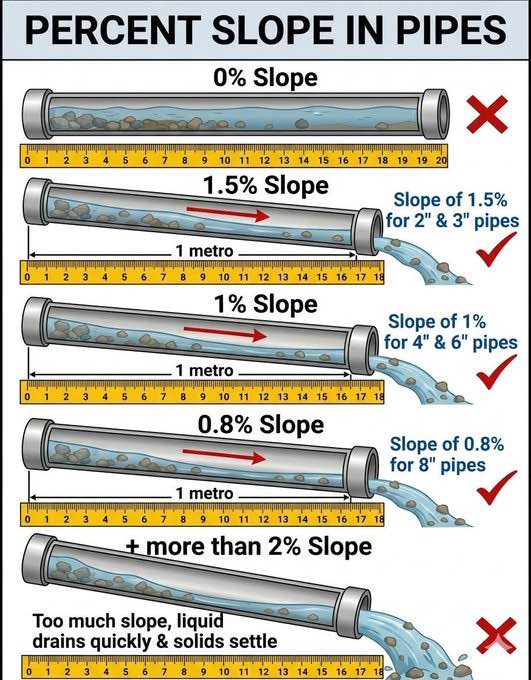
2-inch and 3-inch Pipes
Ideal Slope: 1.5% to 2% (approximately 3/16 to 1/4 inch per foot)
These smaller diameter pipes, commonly used for individual fixture drains (sinks, lavatories, showers), perform optimally with slopes between 1.5% and 2%. The 1/4 inch per foot standard provides excellent flow characteristics while remaining easy to achieve in most installations.
Minimum Acceptable: 1/4 inch per foot (2.08%) Common Practice: 1/4 inch per foot
4-inch and 6-inch Pipes
Ideal Slope: 1% to 2% (approximately 1/8 to 1/4 inch per foot)
Four-inch pipes serve as the workhorse of residential plumbing systems, handling toilet discharge and main branch drains. Six-inch pipes typically serve multiple fixtures or main building drains. Both sizes perform well with slopes in the 1% to 2% range.
Minimum Acceptable: 1/8 inch per foot (1.04%)
Common Practice: 1/8 to 1/4 inch per foot Recommended: 2% when feasible for additional safety margin
8-inch Pipes and Larger
Ideal Slope: 0.8% to 1.5% (approximately 1/16 to 3/16 inch per foot)
Large diameter sewer mains, building drains, and municipal collection systems use 8-inch and larger pipes. Their substantial cross-sectional area allows effective drainage with gentler slopes.
Minimum Acceptable: 1/16 inch per foot (0.52%) Common Practice: 1/16 to 1/8 inch per foot
The Manning Formula in Practice
Professional engineers often use the Manning Formula to calculate required slopes for specific conditions. This formula accounts for:
- Hydraulic radius (pipe diameter divided by four for circular pipes flowing full)
- Average water velocity
- Manning coefficient (roughness factor varying by pipe material)
Using a Manning coefficient of 0.013 (typical for concrete or mortar cement pipes):
- 8-inch diameter pipe: Minimum 0.54 feet per 100 feet (approximately 6.5 inches per 100 feet, or 0.54%)
- 30-inch diameter pipe: Minimum 0.06 feet per 100 feet (less than an inch per 100 feet)
The Zero Slope Problem: Why Level Pipes Always Fail
A drainage pipe installed with 0% slope—completely level—represents the worst-case installation error. Without any downward gradient, gravity provides no driving force to move waste through the system.
Consequences of Zero Slope:
- Immediate Stagnation: Water and waste accumulate in the pipe with no tendency to flow toward the outlet
- Complete Blockage: Solid materials settle immediately, creating obstructions
- Bacterial Growth: Standing wastewater creates ideal conditions for pathogen proliferation
- Septic Conditions: Lack of flow allows anaerobic decomposition, generating hydrogen sulfide gas and foul odors
- Corrosion: Standing sewage accelerates pipe deterioration, particularly in metal pipes
- System Failure: The drainage system becomes completely non-functional
Level pipes may work briefly when completely empty, but the moment any solid waste enters the system, accumulation begins and progressive failure is inevitable. This is why building codes universally require minimum slopes and why zero slope is categorically unacceptable.
The Excessive Slope Problem: When Steeper Isn't Better
While insufficient slope causes obvious problems, slopes exceeding 2-3% can create equally serious issues through a different mechanism.
The Liquid-Solid Separation Phenomenon
When a drainage pipe has excessive slope—typically more than 2-3% for standard applications—water accelerates rapidly while solid waste moves more slowly due to friction against the pipe walls. This velocity differential causes the liquid to "outrun" the solids, leaving them stranded.
Progressive Failure Sequence:
- Initial Separation: Fast-moving water rushes ahead of slower solid waste
- Stranding: Solids remain on the pipe invert without sufficient liquid to mobilize them
- Accumulation: Each flush or discharge adds more stranded solids
- Crust Formation: Accumulated solids dry between uses, creating hard deposits
- Flow Restriction: Built-up material reduces effective pipe diameter
- Complete Blockage: Eventually, the restriction becomes severe enough to stop flow
Additional Problems with Excessive Slopes
Hydraulic Noise: Extremely steep slopes create high-velocity flows that generate excessive noise as water cascades through pipes and fittings. This is particularly problematic in occupied spaces where drainage noise disturbs residents or workers.
Erosion at Joints: Flow velocities exceeding 10 feet per second can cause erosion at pipe joints and connections, particularly in older systems using mortar or caulked joints. This progressive deterioration can lead to leaks and structural failure.
Splash-back and Contamination: In commercial applications, particularly food processing facilities, excessive slopes can cause splash-back when waste enters the drainage system. This spreads contamination and creates sanitation hazards.
Siphoning Effects: Very steep slopes can create siphoning conditions that pull water from fixture traps, breaking the water seal that prevents sewer gases from entering the building.
Practical Slope Ranges: The Green Zone
Based on code requirements, engineering principles, and field experience, the following represent practical "safe zones" for drainage pipe slopes:
Residential Applications
Small Fixtures (2-3 inch): 1/4 inch per foot (2.08%)
- This standard slope works reliably for sinks, showers, and lavatories
- Easy to achieve with standard pipe supports
- Provides good self-cleaning action
Toilet Drains (3-4 inch): 1/8 to 1/4 inch per foot (1.04% to 2.08%)
- 1/4 inch per foot preferred when possible
- 1/8 inch per foot acceptable for longer runs where elevation change is limited
Building Drains (4-6 inch): 1/8 to 1/4 inch per foot (1.04% to 2.08%)
- 1/8 inch per foot meets code minimum
- 2% provides additional margin and better performance
Commercial Applications
Commercial facilities often require steeper slopes due to:
- Higher solid content in wastewater
- Grease and food debris (restaurants, food processing)
- Chemical solutions requiring different viscosity considerations
- Temperature variations affecting flow characteristics
Recommended Commercial Slopes:
- Food service: 1/4 inch per foot minimum, 2-3% preferred
- Industrial facilities: 2-3% for process waste lines
- Healthcare: 2% minimum for reliable sanitation
Maximum Practical Slopes
While codes rarely specify maximum slopes, practical limitations exist:
Recommended Maximums:
- 2-3 inch pipes: 3% maximum in most applications
- 4-6 inch pipes: 2-3% maximum
- 8 inch and larger: 1.5-2% maximum
These limits prevent liquid-solid separation while allowing reasonable flexibility in design and construction.
Common Installation Errors and How to Avoid Them
Error 1: Inconsistent Slopes
Problem: Variations in slope along a pipe run create high spots (crown) or low spots (sag/belly) where waste accumulates.
Solution: Maintain uniform slope throughout entire run using laser levels or string lines. Support pipes every 4 feet for PVC and every 5 feet for cast iron to prevent sagging.
Error 2: Reverse Slopes (Back-Pitch)
Problem: Sections of pipe slope upward against the flow direction, creating pools where nothing can drain.
Solution: Carefully verify slope direction before covering pipes. Use optical levels or digital inclinometers for accuracy. Check slopes at connections where direction changes occur.
Error 3: Insufficient Support
Problem: Long unsupported runs sag over time, creating bellies that accumulate waste.
Solution: Install proper hangers or supports at code-required intervals. Never rely on adjacent piping for support.
Error 4: Failing to Account for Settling
Problem: Buildings settle over time, and pipes installed at minimum acceptable slopes may fall below requirements within a few years.
Solution: Provide slopes slightly above minimum where possible. In areas with known settling issues, use 1/4 inch per foot even for larger pipes.
Error 5: Poor Trade Coordination
Problem: Other utilities installed after drainage can interfere with proper slope, forcing installers to compromise.
Solution: Establish drainage routes early in construction. Protect drain pipe slopes from interference by other trades.
Materials and Their Impact on Slope Requirements
Different pipe materials have varying internal surface roughness, which affects the friction between flowing liquid and the pipe wall. This influences optimal slope requirements:
PVC and HDPE (Smooth-Wall Plastic)
- Very smooth internal surfaces reduce friction
- Can achieve self-cleaning velocity at slightly flatter slopes
- Standard minimum slopes still apply, but performance margin is higher
- Resistant to buildup due to smooth surface
Concrete and Cast Iron (Rough Surfaces)
- Rougher internal surfaces create more friction
- Should use slopes at or above standard minimums
- Ensuring 2% gradient particularly important to prevent catching
- May require periodic cleaning due to surface characteristics
Design Implications
While material properties do affect flow characteristics, building codes establish minimum slopes that apply regardless of material. The codes already account for various materials by setting conservative minimums. Designers should not reduce slopes below code minimums based on material selection—the standards provide appropriate safety margins.
Verification and Testing
During Installation
Slope Verification Methods:
- Laser Levels: Most accurate method for establishing and verifying slopes, particularly for long runs
- Digital Inclinometers: Electronic tools that display exact slope percentage
- String Line and Level: Traditional method using taut string with line level and measuring drop at intervals
- Optical Transit: Professional surveying tool for precise slope establishment
Best Practice: Verify slope at multiple points along the run, particularly:
- At beginning and end
- At connections and fittings
- At support locations
- Where pipes pass through structural elements
Post-Installation Testing
Water Testing: Run large volumes of water through the system while observing flow characteristics:
- Water should flow smoothly without gurgling
- No standing water after flow stops
- No slow drainage or backups
Camera Inspection: For critical installations, camera inspection can verify:
- Uniform slope without sags or crowns
- Proper alignment
- No debris or obstructions
- Quality of connections
Special Conditions and Exceptions
Slab-on-Grade Construction
When drainage pipes run under concrete slabs, corrections are difficult and expensive. Extra care during installation is essential:
- Use 1/4 inch per foot even for larger pipes
- Provide additional slope margin when possible
- Thoroughly test before pouring concrete
- Document slopes for future reference
Existing Building Constraints
When working within existing buildings, elevation constraints may limit achievable slopes:
Options When Ideal Slopes Are Impossible:
- Use smallest practical pipe size (allows steeper slope for same vertical drop)
- Install pumped systems where gravity drainage is inadequate
- Reroute to utilize available elevation difference
- Install more frequent cleanouts for maintenance access
Long Horizontal Runs
Extended horizontal runs require special attention:
Considerations for Runs Over 50 Feet:
- Verify slope with laser level or transit
- Provide intermediate supports to prevent sagging
- Consider installing intermediate cleanouts
- Use consistent slope throughout entire run
- Account for building settlement over time
Combination Waste and Vent Systems
These specialized systems have different slope requirements, with maximum slopes specified in code:
- Maximum slope: 1/2 inch per foot
- Special venting requirements apply
- Horizontal dry venting must slope back toward drain
Maintenance Implications of Proper Slope
Long-Term Performance
Properly sloped drainage systems require minimal maintenance and can operate reliably for 50-100 years. Key maintenance considerations include:
Well-Sloped Systems:
- Infrequent cleaning required (every 5-10 years for preventive maintenance)
- Minimal emergency service calls
- Lower lifetime operating costs
- Longer service life
Poorly-Sloped Systems:
- Frequent cleaning required (annually or more often)
- Regular emergency calls for backups
- Higher operating costs due to repeated service
- Shorter effective service life
- Potential for extensive damage from backups
Cleaning Frequency
Slope directly affects how often sewers must be cleaned. Most municipalities target complete system cleaning every 1-2 years for properly sloped mains. Poorly sloped sections require more frequent attention:
Problem Areas:
- Slope transitions (steep to flat) prone to grease buildup
- Sections with inadequate slope accumulate solids
- Areas with excessive slope may develop erosion issues
Retrofitting and Correction Strategies
When Existing Slopes Are Inadequate
Assessment Steps:
- Verify actual slope using camera inspection or water tests
- Identify problem sections causing backups
- Evaluate extent of correction needed
- Determine most cost-effective remedy
Correction Options:
Minor Adjustments:
- Reposition pipe hangers to improve slope
- Remove and reinstall short sections
- Add supports to eliminate sags
Moderate Corrections:
- Replace sections with properly sloped pipe
- Install cleanouts for improved maintenance access
- Extend runs to reduce slope (if too steep)
Major Corrections:
- Complete pipe replacement
- Rerouting to utilize better elevations
- Installation of pumping systems where gravity drainage cannot work
Cost-Benefit Analysis
Before undertaking slope corrections, consider:
Replacement Costs vs. Ongoing Maintenance:
- Frequent drain cleaning: $150-500 annually
- Emergency backup service: $500-2000 per incident
- Pipe replacement: $50-200 per linear foot
- Pumping system: $2000-8000 installed
For chronic problems, pipe replacement often proves more economical than continued maintenance over the system's lifetime.
Climate and Environmental Considerations
Freeze-Thaw Regions
In cold climates, proper slope becomes even more critical:
- Standing water in poorly sloped pipes can freeze, causing blockages or pipe damage
- Insulation may be required for pipes in unheated spaces
- Slope prevents ice accumulation that could damage pipes
Seismic Zones
Earthquake-prone areas require:
- Flexible connections to accommodate movement
- Proper support to prevent slope changes during seismic events
- Allowance for building settlement and shifting
High Water Table Areas
Locations with high groundwater:
- May require deeper burial or pumping systems
- Groundwater infiltration can affect flow characteristics
- Proper slope helps prevent infiltration-caused backups
Professional Installation: When to Call an Expert
While some drainage work can be DIY projects, certain situations require professional expertise:
Complex Installations Requiring Professionals:
- Commercial or industrial facilities
- Systems serving multiple stories
- Long runs with tight elevation constraints
- Retrofits in existing occupied buildings
- Critical applications (healthcare, food service)
- Work requiring permits and inspections
Professional Benefits:
- Proper tools (laser levels, transits)
- Code knowledge and compliance
- Experience avoiding common pitfalls
- Warranty and liability coverage
- Inspection coordination
The Critical Balance of Proper Slope
The slope of drainage pipes represents a precise engineering balance where "more" is not always better. While 0% slope guarantees immediate failure and slopes below code minimums lead to chronic clogs and backups, excessive slopes create their own problems through liquid-solid separation.
The ideal slopes—1.5% to 2% for small pipes, 1% to 2% for medium pipes, and 0.8% to 1.5% for large pipes—reflect decades of research, field testing, and real-world experience. These gradients maintain flow velocities in the critical range where self-cleaning action prevents accumulation while avoiding the problems of excessive speed.
Understanding and implementing proper slopes is fundamental to drainage system success. Whether installing new construction or correcting existing problems, achieving and maintaining correct slopes ensures reliable, long-term performance. The investment in proper slope installation—through careful measurement, appropriate support, and quality workmanship—prevents far greater costs in maintenance, repairs, and eventual system failure.
In drainage design and installation, precision matters. The difference between a slope of 1% and 2% may seem minor, but it can mean the difference between a system that functions flawlessly for 50 years and one that requires constant maintenance and premature replacement. When it comes to drainage pipe slopes, getting it right the first time is not just best practice—it's essential engineering.


Comments
Post a Comment