The concrete slump test remains one of the most critical quality control procedures on Kenyan construction sites. With recent concerns about building collapses and substandard construction materials making headlines across the country, understanding and properly conducting this simple yet vital test has never been more important.
In Kenya's rapidly growing construction sector, where the government projects a 7.5% growth for 2025/26, ensuring concrete quality through proper testing is essential for building safe, durable structures that can withstand the test of time.
What is the Concrete Slump Test?
The concrete slump test is a field procedure designed to measure the consistency and workability of fresh concrete before it sets. Developed in 1918 by concrete pioneer Duff Abrams, this test evaluates how easily concrete flows and consolidates during placement.
Despite being over a century old, the slump test remains the most widely used on-site test for fresh concrete globally, including throughout Kenya's construction industry. Its popularity stems from its simplicity, low cost, and ability to provide immediate results that can prevent costly mistakes.
Why the Slump Test Matters in Kenya
Kenya's construction industry faces unique challenges that make the slump test particularly important:
Quality Control Crisis: Recent reports from the Kenya Bureau of Standards (KEBS) revealed that in 2022, three out of five cement samples failed basic strength tests. While this improved to 63.4% compliance by late 2023, the issue underscores the critical need for rigorous on-site testing.
Building Safety: Following several high-profile building collapses in Nairobi and other urban centers, proper concrete testing has become a matter of public safety and regulatory compliance.
Climate Considerations: Kenya's diverse climate zones, from the hot coastal regions to the high-altitude areas around Nairobi, affect concrete behavior differently. The slump test helps ensure workability despite these environmental variations.
Regulatory Compliance: KEBS and local authorities increasingly require documented quality control measures, with the slump test being a fundamental requirement.
Understanding Concrete Workability
Before diving into the test procedure, it's essential to understand what workability means in the Kenyan context.
Workability refers to the ease with which concrete can be mixed, transported, placed, compacted, and finished without segregation or bleeding. In Kenya's construction sites, where conditions can vary from congested urban areas to remote rural projects, appropriate workability is crucial.
Factors Affecting Workability in Kenya
Several factors unique to Kenyan construction influence concrete workability:
Water-Cement Ratio: The most critical factor. Kenya's hot climate, especially in regions like Mombasa and Garissa, can cause rapid moisture loss, affecting the water-cement ratio.
Local Aggregates: Kenyan aggregates vary significantly by region. River sand from Machakos behaves differently from coastal sand or quarry dust from Athi River. Angular crushed aggregates from quarries reduce workability compared to rounded river stones.
Admixtures: Modern Kenyan construction increasingly uses chemical admixtures like superplasticizers to improve workability without adding excess water, particularly for pumped concrete in high-rise buildings.
Temperature: Nairobi's mild temperatures (averaging 15-25°C) provide ideal conditions for concrete work, while coastal areas exceeding 30°C require special considerations for slump loss.
Cement Quality: With KEBS reporting variable cement quality in the market, the type and quality of cement significantly affect workability and slump values.
Standards and Regulations in Kenya
While Kenya has developed its own standards through KEBS, the construction industry commonly references international standards for concrete testing:
Applicable Standards
International Standards Commonly Used:
- ASTM C143: Standard Test Method for Slump of Hydraulic-Cement Concrete (United States)
- BS EN 12350-2: Testing fresh concrete - Slump test (British/European Standard)
- IS 1199-1959: Methods of Sampling and Analysis of Concrete (Indian Standard, widely adopted in East Africa)
Kenyan Standards:
- KS 594: Concrete specification
- KS EAS 18-1: Cement standards
- KS 95: Natural Aggregates for Concrete
Key Regulatory Bodies:
- Kenya Bureau of Standards (KEBS): Oversees construction material standards and conducts periodic market surveillance
- Kenya Accreditation Service (KENAS): Accredits testing laboratories
- National Construction Authority (NCA): Regulates construction professionals and standards
KEBS Testing Services
KEBS operates ISO/IEC 17025-accredited laboratories across Kenya that provide:
- On-site slump testing during concrete pours
- Laboratory testing of hardened concrete samples
- Certification and quality assurance services
- Training for construction personnel
Additionally, several private laboratories accredited by KENAS, including SGS Kenya, GeoIssa Material Testing Laboratory, and various regional testing facilities, offer comprehensive concrete testing services.
Equipment Required for Slump Test
Conducting an accurate slump test requires specific equipment that complies with international standards. In Kenya, this equipment is available from construction supply stores in major cities like Nairobi, Mombasa, Kisumu, and Eldoret.
Essential Testing Equipment
1. Slump Cone (Abrams Cone)
- Shape: Frustum of a cone (open at both ends)
- Internal dimensions:
- Top diameter: 100mm (4 inches)
- Bottom diameter: 200mm (8 inches)
- Height: 300mm (12 inches)
- Material: Galvanized steel or high-grade plastic
- Features: Smooth internal surface, foot pieces for stability, handles for vertical lifting
- Typical cost in Kenya: KSh 1,500 - 3,500
2. Base Plate
- Material: Steel, aluminum, or rigid plastic
- Requirements: Non-absorbent, flat, rigid surface
- Some models include integral clamps for securing the cone
- Typical cost: KSh 1,000 - 2,500
3. Tamping Rod
- Material: Steel
- Dimensions: 16mm diameter, 600mm (24 inches) long
- Features: Bullet-shaped or hemispherical tip, rounded at one end
- Important: Never use rebar or other improvised rods
- Typical cost: KSh 800 - 1,500
4. Measuring Tape or Scale
- Type: Standard measuring tape or steel rule
- Accuracy: Readings to nearest 5mm (0.25 inches)
- Typical cost: KSh 200 - 800
5. Optional but Helpful Tools
- Scoop: For transferring concrete to cone
- Trowel: For striking off excess concrete
- Water container: For moistening equipment
- Clean cloth or brush: For equipment cleaning
Where to Buy Equipment in Kenya
Testing equipment is available from:
- Major Cities: Construction equipment suppliers in Nairobi (Industrial Area, Ruaraka), Mombasa, Kisumu, Nakuru, and Eldoret
- Online Platforms: Jumia Kenya, Kilimall, and local construction supply websites
- International Suppliers: Companies like Globetrek Engineering Corporation supply to Kenya and East African markets
- KEBS: Approved suppliers list available from KEBS offices
Step-by-Step Procedure for Conducting Slump Test
Proper execution of the slump test is crucial for reliable results. Here's the detailed procedure adapted for Kenyan construction sites:
Pre-Test Preparation
1. Equipment Preparation
- Clean all equipment thoroughly, removing any dried concrete residue
- Lightly moisten the inside of the slump cone and base plate with clean water (do not leave standing water)
- This prevents the fresh concrete from sticking and provides more accurate results
2. Sample Collection
- Take a representative sample of fresh concrete immediately after mixing
- For ready-mix concrete, sample from the truck after initial discharge
- Ensure the sample represents the entire batch, not just the surface
- Complete the test within 5 minutes of sampling
3. Site Selection
- Choose a flat, stable, vibration-free surface
- Avoid areas near operating machinery or heavy traffic
- Ensure adequate lighting for accurate measurement
- In Kenya's outdoor sites, provide shade if testing in direct sunlight
Testing Procedure
Step 1: Position the Cone
- Place the dampened base plate on a level surface
- Position the slump cone on the base plate, smaller opening upward
- Stand firmly on the foot pieces to prevent movement during filling
Step 2: Fill the Cone in Three Layers
- Layer 1 (Bottom Third):
- Fill approximately one-third of the cone volume (not one-third height)
- Rod the layer 25 times with the tamping rod
- Distribute the strokes evenly across the cross-section
- Ensure the rod penetrates to the base plate but doesn't forcefully strike it
- Layer 2 (Middle Third):
- Add the second third of concrete
- Rod 25 times, allowing the rod to penetrate approximately 25mm into the layer below
- Avoid over-rodding, which can cause segregation
- Layer 3 (Top Third):
- Fill to slightly overfill the cone
- Rod 25 times, penetrating into the previous layer
- Strike off excess concrete with the tamping rod or trowel
- Use a sawing motion to level the top flush with the cone rim
Step 3: Remove the Cone
- Remove your feet from the foot pieces
- Grasp the handles firmly with both hands
- Lift the cone vertically in a steady, continuous motion
- Complete the lift in 5-10 seconds
- Do not twist, rock, or apply lateral motion
- Place the cone beside the slumped concrete for measurement reference
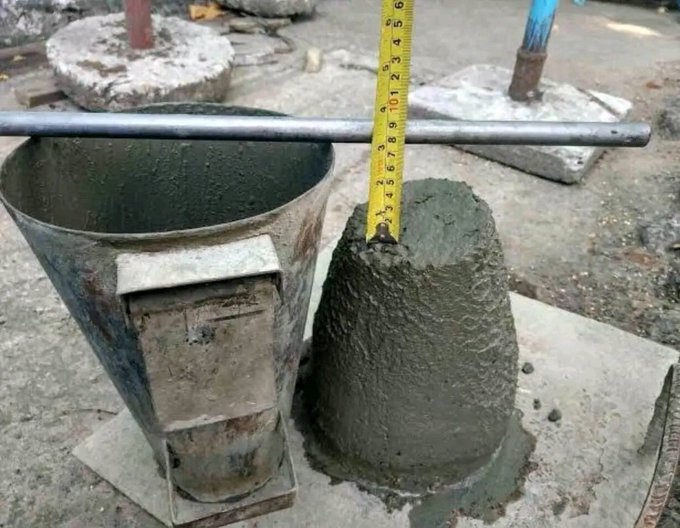
Step 4: Measure the Slump
- Immediately after removing the cone, measure the slump
- Place the tamping rod horizontally across the top of the inverted cone
- Measure vertically from the rod to the highest point of the slumped concrete
- Record the measurement to the nearest 5mm (0.25 inch)
- Complete the entire test within 2.5 minutes from start to finish
Critical Do's and Don'ts
DO:
- ✓ Dampen equipment before use
- ✓ Fill in three equal layers by volume
- ✓ Rod each layer exactly 25 times
- ✓ Lift the cone vertically without rotation
- ✓ Measure immediately after removal
- ✓ Record results promptly with batch details
DON'T:
- ✗ Use dirty or dry equipment
- ✗ Fill by height instead of volume
- ✗ Under-rod or over-rod the layers
- ✗ Twist or shake the cone during removal
- ✗ Delay measurement after cone removal
- ✗ Test concrete that has begun setting
Interpreting Slump Test Results
Understanding what different slump values mean is crucial for quality control on Kenyan construction sites.
Types of Slump
When you remove the cone, the concrete will exhibit one of four basic slump patterns:
1. True Slump ✓
- The concrete mass settles evenly, maintaining its general cone shape
- No material shears away from the main body
- This is the only valid, acceptable result
- Indicates proper cohesion and workability
- Interpretation: Proceed with measurement and evaluation
2. Shear Slump ✗
- One side or portion of the concrete shears and slides away
- Top portion slips sideways from the bottom
- Indication: Lacks cohesion, insufficient binding
- Action Required: Repeat the test; if second test also shows shear slump, reject the batch
3. Collapse Slump ✗
- The entire concrete mass collapses and spreads out
- Complete loss of shape
- Indication: Excessive water content, mix too wet
- Alternative: May indicate high-workability concrete requiring slump-flow test instead
- Action Required: Repeat test; if collapse persists, investigate mix design and water-cement ratio
4. Zero Slump ✗
- Concrete maintains the exact shape of the mold
- No measurable settlement
- Indication: Mix too dry, very low water content
- Typically used only for specialized applications like road paving
- Action Required: For most structural work, this indicates inadequate workability
Slump Value Ranges and Applications
Different construction applications in Kenya require different slump values:
| Slump Range | Classification | Typical Kenyan Applications | Notes |
| 0-25mm | Very Low | Road construction, pavements, machine-placed concrete | Too stiff for most building work |
| 25-50mm | Low | Mass concrete, lightly reinforced foundations, footings | Requires good vibration |
| 50-100mm | Medium | Most common for Kenyan construction: columns, beams, slabs, general structural work | Ideal workability range |
| 100-150mm | High | Heavily reinforced sections, tremie concrete, pumped concrete in high-rises | Common in Nairobi's tall buildings |
| 150-175mm | Very High | Congested reinforcement, complex formwork, self-consolidating applications | Requires admixtures |
| >175mm | Flowing | Special applications only, typically self-consolidating concrete (SCC) | Use slump-flow test instead |
Recommended Slump Values for Common Kenyan Projects
Residential Construction:
- Foundation slabs: 75-100mm
- Columns and beams: 75-125mm
- Floor slabs: 75-100mm
- Walls: 100-150mm
Commercial Buildings:
- Foundations: 50-100mm
- Structural frames: 75-125mm
- Pumped concrete: 100-175mm
- Pre-cast elements: 25-75mm
Infrastructure Projects:
- Road pavements: 0-25mm
- Bridge decks: 50-75mm
- Retaining walls: 75-100mm
- Mass concrete (dams): 25-50mm
Tolerance Ranges
According to international standards commonly applied in Kenya:
- For specified slump ≤ 100mm: Tolerance ± 25mm
- For specified slump > 100mm: Tolerance ± 40mm
Example: If your specification calls for 75mm slump, acceptable range is 50-100mm.
Common Mistakes and How to Avoid Them
Based on extensive experience from Kenyan construction sites, here are the most frequent errors and their solutions:
1. Dirty or Dry Equipment
Mistake: Using the cone without cleaning or moistening it Impact: Concrete sticks to the cone surface, artificially reducing slump by 10-40mm Kenya-Specific Issue: Particularly problematic in hot, dry areas like Machakos, Kajiado, and Garissa Solution:
- Clean cone thoroughly after each test
- Moisten with clean water (not excessively wet)
- In hot conditions, re-moisten equipment between tests
2. Uneven or Absorbent Base Surface
Mistake: Placing cone on dry plywood, soil, or uneven surfaces Impact: Water absorption from concrete base, cone tilting leading to irregular settlement Common in Kenya: Rural construction sites where proper base plates aren't available Solution:
- Always use a flat, rigid, non-absorbent base plate
- Verify level surface with quick visual check
- Carry a portable base plate to remote sites
3. Incorrect Rodding Technique
Mistake:
- Using wrong number of strokes (not 25 per layer)
- Using rebar instead of proper tamping rod
- Rodding too forcefully or too gently
- Not distributing strokes evenly
Impact: Inconsistent compaction, unreliable results varying by ±20-30mm Solution:
- Count strokes carefully: 25 per layer
- Use only proper 16mm diameter tamping rod with rounded tip
- Distribute strokes evenly across cross-section
- Penetrate correct depth into previous layer
4. Delayed Testing
Mistake: Testing concrete that has been mixed for too long Impact: Concrete begins setting, slump decreases significantly Kenya-Specific Issue:
- Heavy traffic in Nairobi can delay concrete trucks 30-60 minutes
- Hot coastal temperatures accelerate setting time
Solution:
- Test within 5 minutes of sampling
- For ready-mix, test immediately upon arrival
- In hot weather, account for transit time when ordering
- Consider using retarding admixtures for long-distance deliveries
5. Improper Cone Removal
Mistake:
- Twisting or rotating the cone during lifting
- Lifting too slowly or too quickly
- Bumping the cone or base during removal
Impact: Irregular slump, shear failure, invalid results Solution:
- Lift steadily and vertically in one smooth motion
- Complete lift in 5-10 seconds
- Avoid any lateral or rotational movement
- Practice the technique for consistency
6. Adding Water On-Site
Critical Issue in Kenya: Site workers adding water to increase slump without approval
Why It's Done:
- To ease placing and finishing
- Compensate for slump loss during transit
- Make pumping easier
Consequences:
- Drastically reduces concrete strength (up to 50% loss)
- Increases shrinkage and cracking
- Violates mix design specifications
- Major contributor to structural failures
Proper Solution:
- Use approved water-reducing admixtures
- Order correct slump from supplier
- Account for slump loss in hot weather
- Reject batch if slump is inadequate rather than add water
- Only authorized personnel should adjust mix with approved admixtures
7. Testing at Wrong Time
Mistake: Testing after concrete has partially set or been vibrated Solution: Always test fresh, undisturbed concrete within specified time limits
8. Environmental Factors
Kenya-Specific Challenges:
- Coastal Humidity: Mombasa's high humidity can affect surface moisture
- High Altitude: Thinner air at elevation (Nairobi at 1,795m) affects concrete differently
- Intense Sunlight: Direct sun causes rapid moisture loss
- Rainy Season: Excess water in aggregates affects mix proportions
Solutions:
- Conduct tests in shaded areas
- Adjust for local aggregate moisture content
- Consider seasonal variations in mix design
- Protect fresh concrete from direct environmental exposure
Factors Affecting Slump in Kenyan Context
Understanding the unique factors in Kenya's construction environment helps in achieving and maintaining desired slump values:
1. Cement Type and Quality
Challenge: Variable cement quality in Kenyan market
- KEBS 2022 report showed 38.1% cement failure rate
- Improved to 63.4% compliance by late 2023, but still concerning
- Different manufacturers produce cement with varying characteristics
Impact on Slump:
- Finer cement requires more water for same slump
- Cement chemistry affects water demand
- Aged or poorly stored cement may require adjustment
Best Practices:
- Source cement from KEBS-certified manufacturers
- Verify Diamond Mark or Standardization Mark
- Store cement properly in dry conditions
- Use fresher cement (within 3 months of manufacture)
2. Aggregate Characteristics
Kenyan Aggregate Sources:
- River sand and ballast: Machakos, Athi River, Thika
- Quarry products: Various locations nationwide
- Coastal sand: Mombasa region (requires washing to remove salt)
Factors Affecting Slump:
- Particle Shape: Angular quarry aggregates reduce slump by 20-30mm compared to rounded river stones
- Surface Texture: Rough surfaces absorb more water
- Grading: Poor grading requires more water
- Moisture Content: Saturated aggregates vs. dry aggregates significantly affect water demand
- Dust Content: Quarry dust increases water requirement
Solutions:
- Test aggregate moisture regularly
- Adjust mix water based on aggregate condition
- Wash salty coastal aggregates thoroughly
- Ensure proper aggregate grading
3. Water Quality
Kenyan Water Considerations:
- Municipal water: Generally suitable (Nairobi City Water, Mombasa Water)
- Borehole water: May contain minerals affecting concrete
- River water: Requires testing for organic content
- Recycled water: Must meet concrete mixing standards
Requirements:
- Water should be clean, free from harmful substances
- pH between 6-8 preferable
- Free from organic matter, oils, salts
- Drinking water quality generally acceptable
4. Chemical Admixtures
Increasingly Common in Kenya:
- Superplasticizers: Used in Nairobi's high-rise construction for pumping
- Water Reducers: Allow slump increase without adding water
- Retarders: Combat rapid setting in hot weather
- Accelerators: Used when faster strength gain needed
Impact: Can increase slump by 50-150mm without affecting water-cement ratio
Availability: Major suppliers include Sika, BASF, Chryso, and local manufacturers
5. Temperature and Climate
Regional Variations:
- Nairobi: Moderate temperatures (15-25°C), minimal slump loss
- Mombasa Coast: Hot (25-35°C), rapid slump loss (25-50mm per hour)
- Western Kenya: High humidity, slower evaporation
- Northern Kenya: Extreme heat and dryness
Temperature Effects:
- Every 5°C increase can reduce slump by 15-25mm
- Hot weather accelerates cement hydration
- Cold weather (rare in Kenya) retards setting
Compensation Strategies:
- Order higher initial slump for hot-weather pours
- Use ice in mixing water for extreme heat
- Schedule pours during cooler morning hours
- Use retarding admixtures in coastal regions
6. Mixing and Transportation
Kenya-Specific Challenges:
- Traffic Congestion: Nairobi's traffic can delay trucks 30-90 minutes
- Road Conditions: Poor roads cause excessive mixing during transport
- Distance: Ready-mix plants may be far from rural sites
- Mixing Quality: Site-mixed concrete often inconsistent
Slump Loss During Transit:
- Typical loss: 25mm per hour in moderate conditions
- Hot weather: 40-60mm per hour possible
- Over-mixing reduces slump and damages concrete
Solutions:
- Communicate expected delays to supplier
- Order appropriate initial slump accounting for transit time
- Use shorter transit times when possible
- Consider on-site mixing for remote locations
- Use mid-range water reducers for extended deliveries
Quality Control and Documentation
Proper documentation is increasingly important in Kenya's construction industry, especially following recent building collapses and regulatory scrutiny.
Record-Keeping Requirements
Every slump test should be documented with:
Basic Information:
- Date and time of test
- Project name and location
- Weather conditions (temperature, humidity)
- Concrete supplier name
- Delivery truck number and batch ticket number
Mix Design Details:
- Specified concrete grade (e.g., C25, C30)
- Specified slump value
- Admixtures used (type and dosage)
- Cement type and brand
Test Results:
- Actual slump value measured
- Type of slump (true, shear, collapse, zero)
- Name of person conducting test
- Test acceptance status (pass/fail)
- Action taken if failed
Sample Format:
CONCRETE SLUMP TEST RECORD -------------------------- Project: _______________ Date: _________ Time: _______ Location: ______________ Temperature: _____ Weather: _____ Supplier: ______________ Truck No: _____ Batch No: _____ Mix Design: Grade _____ Specified Slump: _____ mm Admixtures: ___________________ TEST RESULTS: Measured Slump: _____ mm Slump Type: [ ] True [ ] Shear [ ] Collapse [ ] Zero Acceptance: [ ] Pass [ ] Fail Tested by: ______________ Signature: __________ Action Taken: _______________________
Testing Frequency
Recommended Testing Schedule for Kenyan Sites:
Small Projects (Single house, small commercial):
- Minimum one test per pour
- One test per 20 cubic meters of concrete
- Additional test if mixing time exceeds 1 hour
Medium Projects (Apartment blocks, offices):
- One test per 50 cubic meters
- Minimum three tests per day of pouring
- One test per truck for pumped concrete
Large Projects (High-rises, infrastructure):
- One test per truck delivery
- One test every 2 hours of continuous pouring
- Additional tests for critical structural elements
NCA and KEBS Requirements:
- Follow project specifications
- Maintain records for minimum 5 years
- Make records available for inspection
- Report consistent failures to authorities
When to Reject Concrete
Reject a concrete batch if:
- Slump value falls outside specified tolerance range
- Second test (after shear or collapse) still fails
- Slump loss indicates concrete has begun setting
- Unauthorized water has been added
- Concrete shows signs of segregation or bleeding
- Delivery time exceeds 90 minutes (or 2 hours with retarder)
Important: Document reasons for rejection and notify supplier immediately.
Troubleshooting Common Issues
Problem: Slump Too Low
Possible Causes:
- Insufficient mixing water
- Excessive absorption by dry aggregates
- Slump loss due to delayed testing
- Hot weather causing rapid moisture loss
- Cement with high water demand
Solutions:
- DO NOT add water on site without authorization
- Contact supplier for approved water-reducing admixture
- Adjust future batches based on conditions
- Account for transit time and temperature in initial order
- Verify aggregate moisture content
Problem: Slump Too High
Possible Causes:
- Excess water in mix
- Saturated aggregates not accounted for
- Incorrect batching at plant
- Rain contamination
Solutions:
- Reject batch if significantly over specification
- Investigate batching process with supplier
- Protect aggregates from rain
- Adjust future batches for aggregate moisture
- Consider using in non-critical areas if only slightly high
Problem: Inconsistent Results
Possible Causes:
- Variable testing technique
- Dirty or improper equipment
- Inconsistent mix from supplier
- Environmental variations
Solutions:
- Standardize testing procedure among site personnel
- Train all testers on proper technique
- Maintain and clean equipment regularly
- Document all variables for each test
- Discuss variability with supplier
Problem: Rapid Slump Loss
Common in Hot Kenyan Weather, Especially Coast and Northern Regions
Causes:
- High ambient temperature (>30°C)
- Direct sunlight on concrete
- High cement content mixes
- Inadequate use of retarders
Solutions:
- Test immediately upon arrival
- Order higher initial slump to account for loss
- Use approved retarding admixtures
- Schedule pours during cooler hours (early morning)
- Use chilled mixing water or ice
- Shade concrete during transport and placement
- Plan for faster placement and finishing
Safety Considerations
While the slump test is relatively simple, safety should never be overlooked:
Personal Protective Equipment (PPE)
Required PPE:
- Safety boots (steel-toed)
- Hard hat
- Safety glasses or goggles
- Gloves (concrete is caustic)
- Long-sleeved shirt and long pants
- High-visibility vest (on active construction sites)
Why It Matters: Fresh concrete has a pH of 12-13 (highly alkaline) and can cause:
- Skin burns with prolonged contact
- Eye damage if splashed
- Respiratory irritation from cement dust
Site Safety
- Clear testing area of obstacles
- Ensure stable, level surface
- Keep equipment away from traffic areas
- Dispose of test concrete properly
- Wash hands and exposed skin after testing
- Have clean water available for emergency washing
Kenyan Workplace Safety Regulations
- Comply with Occupational Safety and Health Act (OSHA) 2007
- Follow site-specific safety protocols
- Report any accidents or near-misses
- Ensure all personnel are trained
Advanced Considerations
Slump-Flow Test for Self-Consolidating Concrete
For highly flowable mixes (slump >175mm) common in modern Kenyan high-rises:
Procedure:
- Use modified or standard slump cone
- Measure spread diameter instead of vertical drop
- Typical spread: 500-700mm for SCC
- Evaluate visual stability index (segregation resistance)
Applications in Kenya:
- Congested reinforcement in tall buildings
- Complex architectural forms
- Precast concrete production
- Situations requiring minimal vibration
Effect of Pumping
Pumping is increasingly common in Nairobi's vertical construction:
Slump Requirements for Pumping:
- Minimum 75mm for short-distance pumping
- 100-150mm for typical pumped applications
- 125-175mm for high-rise pumping (>20 floors)
- Higher slump for long horizontal or vertical distances
Considerations:
- Pumping increases concrete temperature
- Mix proportions may need adjustment
- Use of mid-range water reducers common
- Test slump at pump discharge, not just at truck
Correlation with Strength
Important Understanding:
- Slump does NOT directly measure strength
- High slump with proper water-cement ratio (using admixtures) can achieve high strength
- High slump from excess water will reduce strength significantly
- Always conduct compressive strength tests (cube or cylinder tests at 7 and 28 days)
Rule of Thumb:
- Every 25mm slump increase from added water can reduce strength by 3-5%
- This is why adding water on-site is so detrimental
Relationship with Other Concrete Tests
The slump test is part of a comprehensive quality control program:
Fresh Concrete Tests (Conducted Together)
Air Content Test:
- Measures air bubbles in concrete
- Critical for freeze-thaw resistance (less relevant in most of Kenya)
- Important for durability in specific applications
Temperature Test:
- Concrete temperature should be 10-32°C for placement
- Hot weather requires monitoring (common in coastal Kenya)
- Affects setting time and strength development
Unit Weight (Density) Test:
- Verifies correct material proportions
- Detects excessive air or water content
- Confirms specified concrete grade
Hardened Concrete Tests (Later Verification)
Compressive Strength Test (Most Important):
- Standard cubes: 150mm × 150mm × 150mm
- Tested at 7 days and 28 days
- Primary acceptance criterion for structural concrete
- Required for all structural elements
Rebound Hammer Test:
- Non-destructive test for in-place concrete
- Commonly used by KEBS inspectors
- Provides estimate of surface hardness and strength
- Complements destructive testing
Core Testing:
- Drilled samples from hardened structure
- Used when cube tests fail or concrete quality is questioned
- More expensive but definitive
- Common in dispute resolution
Role of KEBS and Certified Laboratories
KEBS Testing Services
The Kenya Bureau of Standards plays a crucial role in concrete quality assurance:
Services Provided:
- On-site slump testing during concrete pours
- Laboratory testing of fresh and hardened concrete
- Certification of materials and products
- Market surveillance of construction materials
- Training and capacity building
- Standards development
Accreditation:
- KEBS laboratories accredited by South African National Accreditation System (SANAS)
- ISO/IEC 17025 compliance
- Accredited for approximately 300 tests
Contact Information:
- Toll-Free Number: 1545 (Monday-Friday, 8:00 AM - 5:00 PM)
- Report substandard products through Wajibika Na KEBS program
- Verify S-Mark permit by sending code to 20023
Certified Private Laboratories
Several KENAS-accredited laboratories operate across Kenya:
Major Testing Laboratories:
- SGS Kenya
- Comprehensive concrete and aggregate testing
- On-site and laboratory services
- International quality standards
- GeoIssa Material Testing Laboratory (Nairobi)
- Testing for concrete, aggregates, soils, and rocks
- Structural and geotechnical services
- Materials Testing and Research Division (MTRD)
- Ministry of Transport facility
- Central laboratory in Nairobi
- 16 regional labs nationwide
- Geotechnical and materials testing
- Regional University Laboratories
- University of Nairobi, JKUAT, Moi University
- Academic and commercial testing services
- Research and development support
Choosing a Laboratory:
- Verify KENAS accreditation
- Check scope of accreditation for specific tests
- Consider location and turnaround time
- Compare costs and service quality
- Confirm reporting format meets project requirements
Case Studies: Lessons from Kenyan Construction
Case Study 1: Building Collapse in Nairobi (Composite Example)
Background: Multiple building collapses in Nairobi's Huruma, Embakasi, and other areas between 2016-2024 revealed systematic quality control failures.
Findings: Investigations revealed:
- Substandard concrete materials used
- No documented quality control testing
- Unauthorized water additions on-site
- Weak mix designs relative to structural requirements
- Lack of professional supervision
Slump Test Implications:
- Proper slump testing could have detected anomalies
- Documentation would have created accountability
- Regular testing discourages malpractice
- Professional oversight essential
Lessons for Industry:
- Never skip quality control testing to save time or money
- Document all test results
- Reject non-compliant batches regardless of schedule pressure
- Engage qualified professionals for supervision
Case Study 2: Successful High-Rise Project - Nairobi
Project: Modern high-rise building in Nairobi's Westlands area
Quality Control Approach:
- Slump test for every concrete truck delivery
- Target slump: 125mm for pumped concrete
- Use of approved superplasticizers
- Comprehensive documentation
- Real-time communication with ready-mix supplier
Results:
- Consistent concrete quality throughout project
- All cube tests passed at 28 days
- Smooth pumping operations with minimal blockages
- Zero structural issues during and after construction
- Project completed on schedule
Key Success Factors:
- Professional supervision by qualified engineers
- Partnership with reputable ready-mix supplier
- Investment in proper testing equipment
- Trained site personnel
- Commitment to standards
Case Study 3: Remote Project - Northern Kenya
Challenge: Infrastructure project in remote area with:
- No ready-mix suppliers nearby
- High temperatures (35-40°C)
- Limited testing equipment
- Site-mixed concrete
Solutions Implemented:
- Purchased basic slump testing equipment (cone, rod, base plate)
- Trained site workers on proper procedure
- Adjusted mix design for high temperatures
- Used retarding admixtures
- Conducted tests early morning
- Doubled testing frequency due to conditions
Outcomes:
- Maintained quality despite challenging conditions
- Documented compliance for client and authorities
- Avoided costly failures
- Built capacity among local workforce
Lessons:
- Basic equipment is affordable and essential
- Training local personnel is invaluable
- Environmental conditions must inform approach
- Documentation protects all parties
Training and Capacity Building
Training Site Personnel
Essential Training Components:
- Theoretical Understanding:
- Purpose and importance of slump test
- Relationship to concrete workability and strength
- Standards and specifications
- Kenyan regulatory requirements
- Practical Skills:
- Proper equipment handling
- Step-by-step test procedure
- Accurate measurement techniques
- Result interpretation
- Documentation:
- Record-keeping requirements
- Reporting procedures
- Data management
- Safety:
- PPE requirements
- Concrete hazards
- Emergency procedures
Training Providers in Kenya:
- National Construction Authority (NCA)
- Offers various construction-related training
- Certification programs for construction professionals
- Contact through county offices
- KEBS Academy
- Standards and quality management training
- Testing procedures and calibration
- Contact: KEBS headquarters, Popo Road, Nairobi
- Technical and Vocational Education and Training (TVET) Institutions
- Kenya Polytechnic University College
- Mombasa Technical University
- Regional technical training institutes
- Construction Industry Associations
- Kenya National Highways Authority (KeNHA) training programs
- National Construction Authority professional development
- Private sector training providers
Internal Training Options:
- Engage qualified engineers to train site teams
- Develop standard operating procedures (SOPs)
- Conduct regular refresher sessions
- Create mentorship programs pairing experienced with new workers
Digital Tools and Technology
Modern technology is transforming concrete quality control in Kenya:
Mobile Apps and Digital Recording
Advantages:
- Instant data capture and storage
- GPS and timestamp verification
- Photo documentation of tests
- Cloud-based data management
- Real-time reporting to stakeholders
- Historical data analysis
Available Tools:
- Various construction management apps support quality control
- Custom spreadsheets on tablets
- WhatsApp groups for instant communication (common in Kenya)
- Dedicated concrete testing software
QR Codes and Traceability
Emerging Practice:
- QR codes on concrete delivery tickets
- Link to batch information and test results
- Enhanced traceability and accountability
- Reduces documentation errors
Future Trends
Internet of Things (IoT):
- Sensors in concrete for real-time monitoring
- Automated slump measurement devices
- Temperature and humidity tracking
- Cloud-based quality management systems
Adoption in Kenya:
- Currently limited to major projects and progressive companies
- Growing interest among Nairobi-based contractors
- Infrastructure projects increasingly require digital documentation
Cost-Benefit Analysis
Investment in Quality Control
Basic Equipment Costs (One-time):
- Slump cone: KSh 1,500 - 3,500
- Base plate: KSh 1,000 - 2,500
- Tamping rod: KSh 800 - 1,500
- Measuring tape: KSh 200 - 800
- Total Initial Investment: KSh 3,500 - 8,300
Ongoing Costs:
- Personnel time: ~15 minutes per test
- Equipment maintenance: Minimal (cleaning)
- Replacement after damage: Rare if properly maintained
- Documentation and record-keeping: ~5 minutes per test
Professional Testing Services (Alternative):
- KEBS on-site testing: KSh 3,000 - 5,000 per visit
- Private laboratory services: KSh 2,500 - 6,000 per test
- For projects requiring frequent testing, in-house capability more economical
Costs of NOT Testing
Potential Consequences:
- Structural failures requiring demolition: KSh 500,000 - Millions
- Repair and remediation: KSh 100,000 - Millions
- Legal liability and lawsuits: Unlimited
- Loss of professional reputation: Incalculable
- Project delays: KSh 50,000 - 500,000+ per day
- Injury or loss of life: Catastrophic
Real Examples from Kenya:
- Building collapses have resulted in deaths, injuries, and millions in losses
- Demolition orders for substandard buildings
- Prosecutions of developers and contractors
- Loss of professional licenses
Clear Conclusion: Investment in proper testing is negligible compared to potential costs of failure.
Frequently Asked Questions (FAQs)
General Questions
Q: How often should I conduct slump tests on my construction site? A: For most projects, test at least once per concrete pour, and once per 20-50 cubic meters of concrete. Larger projects should test more frequently - typically one test per truck delivery for pumped concrete or critical structural elements.
Q: Can I use the same concrete if the slump test fails? A: It depends on the specification and how far outside tolerance the result is. Small deviations might be acceptable for non-critical applications after engineering review. Significant failures require rejection of the batch. Never add water on-site to correct low slump without explicit authorization from the mix designer.
Q: Where can I buy slump test equipment in Kenya? A: Equipment is available from construction supply stores in major cities (Nairobi's Industrial Area, Mombasa, Kisumu, Nakuru, Eldoret). Online platforms like Jumia Kenya also carry testing equipment. KEBS can provide a list of approved suppliers.
Q: Do I need certification to conduct slump tests? A: While specific certification isn't legally required for basic site testing, personnel should be properly trained. For official documentation and critical projects, tests should be supervised by qualified technicians or engineers. Consider training through KEBS, NCA, or TVET institutions.
Q: How long does concrete remain testable after mixing? A: Test within 5 minutes of sampling for accurate results. Generally, concrete should be placed within 90 minutes of mixing (or up to 2 hours with approved retarding admixtures). Hot weather significantly reduces this time.
Technical Questions
Q: What if my test shows a shear slump? A: Shear slump indicates poor cohesion, often from inadequate cement content or poor mix design. Conduct a second test on a fresh sample. If the second test also shows shear failure, reject the batch and contact your supplier.
Q: Why does slump decrease during transportation? A: Cement hydration begins immediately when water is added, gradually stiffening the mix. Hot weather, long transit times, and over-mixing accelerate this process. Typical slump loss is 25mm per hour in moderate conditions, but can be 40-60mm per hour in Kenya's hot coastal areas.
Q: Can I add water to increase slump? A: Never add water on-site without explicit written authorization from the design engineer or concrete supplier. Adding water drastically reduces concrete strength (up to 50% loss possible) and is a major cause of structural failures. Use approved chemical admixtures instead.
Q: What's the difference between slump and strength? A: Slump measures workability (how easily concrete flows), not strength. High slump achieved with proper admixtures can produce high-strength concrete. However, high slump from excess water will produce weak concrete. Strength is measured separately through cube or cylinder tests at 7 and 28 days.
Q: How do I account for hot weather in Kenya's coastal and northern regions? A: Order higher initial slump to account for transit loss, use approved retarding admixtures, schedule pours during cooler morning hours, consider chilled mixing water, test immediately upon arrival, and plan for rapid placement and finishing.
Regulatory Questions
Q: What are Kenya's official standards for concrete testing? A: Kenya follows KEBS standards (KS series) which are often aligned with British Standards (BS) and East African Standards (EAS). The slump test typically references ASTM C143, BS EN 12350-2, or IS 1199-1959. Always verify specific project requirements with your engineer.
Q: Can KEBS inspect my construction site? A: Yes, KEBS conducts market surveillance and can visit construction sites to verify compliance with standards. They can test materials and issue stop-work orders for non-compliant practices. Maintain proper documentation and quality control to demonstrate compliance.
Q: What happens if my project uses substandard concrete? A: Consequences can include: stop-work orders, demolition requirements, professional license suspension or revocation, legal liability, project delays, and in cases of failure causing injury or death, criminal prosecution. The National Construction Authority (NCA) actively pursues enforcement.
Q: How long should I keep slump test records? A: Maintain records for minimum 5 years, preferably for the life of the structure. These records may be required for: regulatory inspections, dispute resolution, warranty claims, future modifications, or legal proceedings.
Practical Site Questions
Q: What if my ready-mix truck arrives with low slump due to traffic delays? A: Do not add water. Options include: (1) Reject the load if outside specification, (2) Contact supplier for approved admixture addition (must be done by supplier's personnel), (3) Use concrete in less critical areas if engineering approves slightly low slump, (4) Document the issue and circumstances.
Q: Can I reuse concrete from failed slump tests? A: No, never return tested concrete to the delivery truck or mix it with fresh concrete. This contaminates the batch and compromises quality. Dispose of test samples properly or use for non-structural purposes like temporary walkways after informing relevant parties.
Q: How do I clean slump test equipment? A: Clean immediately after each test using water and a stiff brush. Remove all concrete residue before it hardens. For hardened concrete, use a wire brush or scraper. Store equipment clean and dry. Regular maintenance ensures accurate results and extends equipment life.
Conclusion
The concrete slump test remains an indispensable tool in Kenya's construction industry. Despite its century-old origins, this simple procedure provides critical information about concrete quality that can mean the difference between a safe, durable structure and a catastrophic failure.
Key Takeaways for Kenyan Construction Professionals
1. Non-Negotiable Importance In an industry where KEBS reports have historically shown 40-60% material failure rates, rigorous quality control through simple tests like the slump test is essential. Recent improvements demonstrate that commitment to standards works.
2. Proper Technique Matters The difference between reliable and meaningless results lies in following proper procedure: clean moistened equipment, three equal layers, 25 rods each, vertical lift, immediate measurement. Shortcuts compromise accuracy.
3. Context-Specific Adaptation Kenya's diverse climate zones—from Mombasa's heat to Nairobi's moderate temperatures to the arid north—require understanding how environment affects concrete behavior. Adjust expectations and procedures accordingly.
4. Documentation Creates Accountability Written records of every test create a quality trail that protects all parties: clients, contractors, engineers, and most importantly, future building occupants. This documentation is increasingly required by regulators.
5. Cost-Effective Prevention An investment of KSh 3,500-8,300 in testing equipment is negligible compared to potential costs of structural failure. Professional testing services, while valuable, can be supplemented with properly trained in-house capability.
6. Never Compromise on Water-Cement Ratio Adding water on-site to increase workability is perhaps the single most destructive practice in concrete construction. It's the primary cause of strength loss and contributes to structural failures. Always use approved admixtures instead.
7. Continuous Learning Standards evolve, materials change, and techniques improve. Stay current through training, professional development, and engagement with organizations like KEBS, NCA, and industry associations.
Moving Forward
As Kenya continues its impressive infrastructure development and urban growth, the construction industry must elevate its quality standards. The slump test, while just one component of comprehensive quality control, represents a commitment to excellence that every construction professional can implement immediately.
For Building Owners and Developers: Insist on documented quality control. Your investment deserves protection through proper testing.
For Contractors: Invest in equipment and training. Your reputation depends on delivering quality work that stands the test of time.
For Engineers and Supervisors: Don't compromise professional standards for schedule or cost pressure. Lives depend on your decisions.
For Site Workers: Take pride in proper testing technique. You're the frontline of quality assurance.
Final Thought
Every building collapse, every structural failure, represents not just economic loss but potential tragedy. The concrete slump test is a small procedure with enormous implications. When conducted properly, documented thoroughly, and used as part of comprehensive quality control, it contributes to the safety and durability of Kenya's built environment.
In the words of quality pioneer W. Edwards Deming: "Quality is everyone's responsibility." In Kenya's construction industry, that responsibility begins with something as simple as a proper slump test.
Additional Resources
Kenyan Organizations and Contacts
Kenya Bureau of Standards (KEBS)
- Toll-Free: 1545
- Website: http://www.kebs.org
- Email: info@kebs.org
- Address: Popo Road, off Mombasa Road, Nairobi
National Construction Authority (NCA)
- Website: http://www.nca.go.ke
- Email: info@nca.go.ke
- Nairobi Office: West Park Suites, Mpesi Lane, Westlands
Kenya Accreditation Service (KENAS)
International Standards Organizations
ASTM International
British Standards Institution (BSI)
Bureau of Indian Standards (BIS)
Further Reading
- KEBS Standards Catalogue (available at KEBS offices)
- "Properties of Concrete" by A.M. Neville (comprehensive textbook)
- Anthropic's Claude AI for construction queries and calculations
- Kenya Association of Building and Civil Engineering Contractors materials
- Ministry of Transport, Infrastructure, Housing and Urban Development publications
Training Opportunities
- KEBS Academy: Regular courses on standards and quality management
- NCA Continuing Professional Development (CPD) programs
- TVET institutions across Kenya offering construction technology courses
- Online resources from international concrete associations
This article was researched and written for Makaobora.com, your trusted source for construction knowledge and expertise in Kenya. For professional construction services, consultations, or training, contact Makaobora.com.
Disclaimer: This article provides general information about concrete slump testing in the Kenyan context. Always consult with qualified structural engineers and follow project-specific specifications, local regulations, and current KEBS standards for your construction project. Material standards and regulations may change; verify current requirements with appropriate authorities.




Comments
Post a Comment