If you've ever stood near a railway track or traveled by train, you've likely noticed the layer of crushed stones packed beneath and around the railroad ties. These stones, known as railway ballast, are far from decorative—they serve multiple critical engineering functions that ensure the safety, stability, and longevity of railway systems worldwide. This comprehensive guide explores the science, specifications, and essential purposes behind the use of crushed stones in railway track construction.
Understanding Railway Ballast: Definition and Origin
Railway ballast refers to the crushed stone material that forms the trackbed upon which railroad ties (also called sleepers) are laid. The term "ballast" originates from a nautical term for the stones used to stabilize ships, and in railway engineering, it serves a remarkably similar purpose—providing stability and preventing movement.
Track ballast is packed between, below, and around the ties to bear the compression load of the railroad ties, rails, and rolling stock, to stabilize and restrain lateral movement of the track, to facilitate drainage, and to keep down vegetation that can compromise the integrity of the combined track structure.
Not all railway tracks use ballast—some modern systems employ ballastless track designs—but ballasted track remains the dominant infrastructure for most railroad networks globally due to its proven effectiveness and adaptability.
The Multiple Critical Functions of Railway Ballast
1. Load Distribution and Bearing Capacity
One of the primary functions of railway ballast is to distribute the enormous loads generated by passing trains across a wider area of the underlying formation or subgrade.
When a train passes over railway tracks, today's trains can exert a force of 100 psi (pounds per square inch) on the track structure. Without proper ballast, this concentrated load would be transmitted directly to the underlying soil, causing excessive pressure that would lead to track settlement, deformation, and eventual failure.
The ballast layer distributes this weight from the railroad ties to a much larger area of the formation beneath, reducing the pressure per unit area to levels that the soil can safely support. This load distribution function is achieved through the interlocking network of angular stone particles that effectively spread forces throughout the ballast mass.
The depth of ballast varies based on traffic density and load requirements, with standard depths ranging from 200mm to 300mm beneath sleepers, and high-speed railway lines potentially requiring ballast up to 0.5 meters thick.
2. Track Stability and Position Maintenance
Railway ballast plays an instrumental role in holding railway tracks securely in their designed position, preventing both lateral (side-to-side) and longitudinal (along the track) movement.
Lateral Stability: The ballast forms substantial "shoulders" extending beyond the track width that restrain lateral movement. This shoulder should be at least 150mm wide and may be as wide as 450mm, with most railways using between 300mm and 400mm. These shoulders are essential for preventing track shift, particularly during temperature-induced rail expansion and contraction.
Longitudinal Stability: When trains accelerate or brake, they create longitudinal forces that can cause track creep—the gradual movement of rails in the direction of train travel. The ballast, when properly compacted around sleepers, provides resistance against this longitudinal displacement.
Vertical Support: The ballast maintains the vertical position of the track, preventing settlement and ensuring the track remains at the correct elevation. When the trackbed becomes uneven, additional ballast can be packed underneath sunken ties through a process called tamping to restore proper track geometry.
3. Superior Drainage Management
Effective water drainage represents one of the most critical functions of railway ballast, directly impacting track longevity and safety.
Railway ballast creates an effective drainage system that prevents water from settling around railroad tracks. Water accumulation poses multiple dangers: it softens the ground beneath the tracks, reduces soil bearing capacity, accelerates material deterioration, and in freezing conditions, can cause frost heave that lifts and distorts the track structure.
The voids between ballast stones—typically occupying 40-45% of the ballast volume—allow water to drain rapidly through the ballast layer rather than accumulating near the track. The ballast around tracks is always sloped downward and away from the tracks, directing water flow away from the critical load-bearing areas.
To optimize drainage, track ballast typically rests on a layer of sub-ballast consisting of smaller crushed stones that provide solid support for the top ballast while reducing water ingress from the underlying ground.
4. Vibration and Noise Reduction
The crushed stone ballast serves as a shock-absorbing medium that reduces vibrations generated by passing trains, protecting both the track structure and nearby developments.
When a train passes over tracks, the wheels generate considerable impact forces, particularly at rail joints where wheels encounter slight elevation differences. The instantaneous pressure on the track can reach twice the static weight of the train. Without ballast to absorb and dissipate this impact energy, these forces would be transmitted directly to the subgrade, causing accelerated deterioration and settlement.
Research indicates that ballast less than 300mm thick can lead to vibrations that damage nearby structures. However, increasing depth beyond 300mm confers no extra benefit in reducing vibration, indicating an optimal thickness range for this function.
In some installations, an elastic mat is placed between the sub-ballast and ballast layer, significantly reducing vibration transmission to surrounding areas—particularly important in urban environments where rail lines run near residential or commercial buildings.
5. Vegetation Control and Track Maintenance
Railway ballast acts as a barrier preventing weeds and other vegetation from growing freely on and around railroad tracks. While small plants may seem harmless, they can actually undermine the ground beneath the railroad tracks in several ways:
- Plant roots weaken and destabilize the soil structure
- Vegetation holds moisture near the track, promoting rot in wooden sleepers and corrosion in metal components
- Growing plants can lift and displace ballast stones
- Dense vegetation obscures visual inspection of track components and drainage systems
The harsh, well-drained environment created by crushed stone ballast is inhospitable to most plant growth, maintaining clear sight lines along the track and preserving the structural integrity of the formation.
6. Track Flexibility and Elasticity
Despite providing rigid support, ballast also introduces beneficial flexibility to the track system. This seemingly contradictory property—simultaneous rigidity and flexibility—proves essential for railway operation.
The ballast provides elasticity to the railway track, offering proper riding comfort for passengers while allowing the track structure to accommodate minor ground movements, settlement, and thermal expansion without catastrophic failure. This elastic behavior absorbs dynamic loads, reducing stress on individual track components and extending their service life.
The quantity of voids in ballast plays a key role in providing elasticity to the track. Cubical shape, larger size, and uniform grading provide more voids, though slight grading is necessary to achieve optimal stability profile.
Why Crushed Stones? The Importance of Angular Shape
A fundamental question arises: why crushed stones specifically, rather than naturally rounded stones like river rocks or beach pebbles?
The answer lies in particle geometry and interlocking behavior.
The Critical Role of Angularity
Stones must be irregular with sharp edges to ensure they properly interlock with each other and the ties, fully securing them against movement. The angular nature of crushed ballast allows the stones to lock in place mechanically through their irregular surfaces and sharp corners.
If smooth, rounded stones were used—such as river rock—the pebbles would roll over or slide against one another when trains pass. This rolling and sliding would eliminate the structural stability that ballast provides, allowing the track to shift laterally, settle excessively, and ultimately fail.
Railway ballast specifications explicitly require that individual pieces should not be flaky and should have generally flat faces with not more than two rounded or sub-rounded faces. This specification ensures maximum interlocking capability.
Particle Shape Requirements
Quality ballast should be cubical in shape as far as possible, free from weathered portions of parent rock, organic impurities, and inorganic residues. The cubical form provides optimal interlocking characteristics while maintaining adequate void space for drainage.
Flakiness and elongation indices are carefully controlled in ballast specifications because irregularly shaped particles reduce interlocking effectiveness and are more prone to breakage under load, degrading the ballast's performance over time.
Material Specifications and Quality Requirements
Common Ballast Materials
Railway ballast is typically composed of materials selected for their durability and ability to withstand the weight and pressure of passing trains:
Crushed Stone (Most Common): The preferred material for modern railway ballast, crushed stone is selected for its strength and angularity. Common rock types include:
- Granite: Highly durable with excellent crushing resistance
- Limestone: Hard stone that locks together well, frequently used due to availability
- Quartzite: Extremely hard and wear-resistant
- Basalt: Dense igneous rock with superior strength properties
Broken stones made from hard igneous rock and hard limestone are the most widely used materials for high-speed tracks and main lines.
Gravel: Although less common than crushed stone, properly screened and angular gravel is sometimes used, particularly in secondary lines or where crushed stone is less available.
Slag: A by-product of metal smelting, slag has been used as ballast material in industrial areas where it's readily available, though it's less common in modern construction.
Historical Alternatives: In years past, railroads resourcefully used whatever materials were available, including coal cinders (particularly on light-density lines, creating jet-black trackbeds), burnt clay, sand, and torpedo gravel. These alternatives are rarely used in modern main-line construction due to inferior performance characteristics.
Size and Gradation Specifications
Railway ballast specifications include precise gradation requirements that determine performance characteristics in field applications.
Standard Size Range: Quality ballast typically ranges from 28mm to 50mm in particle size, creating void spaces large enough for drainage while maintaining structural integrity. UK Network Rail specifications call for graded aggregate typically between 32mm and 50mm.
Gradation Requirements: While historical practices favored smaller ballast (around 20mm), modern high-speed railways have increased ballast size, with some French high-speed lines using particles up to 80mm. Research suggests slightly graded ballast with uniformity coefficients between 2.3 and 2.6 provides optimal performance.
Depth Requirements: Track ballast should never be laid less than 150mm thick. High-speed railway lines may require up to 500mm of ballast thickness. Insufficient depth causes overloading of the underlying soil, leading to uneven track settlement.
For Indian broad gauge tracks, the minimum ballast depth is 250mm, while meter gauge requires 200mm minimum depth.
Physical Property Requirements
Quality ballast material must demonstrate exceptional resistance to crushing, abrasion, weathering, and chemical deterioration through standardized testing protocols:
Hardness Testing: Material hardness, measured using Los Angeles abrasion testing, predicts how particles will withstand crushing forces during track tamping operations and train passages. Typical specifications require Los Angeles abrasion values below specific thresholds to ensure adequate durability.
Impact Resistance: Impact value testing measures a stone's resistance to sudden shock loads, simulating the repeated impacts from train wheels.
Water Absorption: Low water absorption (typically below 2-3% by weight) indicates dense, non-porous stone that won't deteriorate rapidly through freeze-thaw cycles or chemical action.
Durability: Ballast must be durable, as it is governed by mineral composition and porosity. Since ballast is used in large quantities, local materials are preferred if they satisfy quality requirements, reducing transportation costs and environmental impact.
The Sub-Ballast Layer: Hidden Support System
Beneath the visible ballast layer lies another critical component: the sub-ballast.
This layer of smaller crushed stones or even pavement acts as a moisture barrier and provides an added support system for the railroad track structure above. Sub-ballast is always the first component of the track structure to be laid down and represents a vital, unseen component of the system.
The sub-ballast layer serves multiple functions:
- Provides a solid, uniform support surface for the ballast layer
- Acts as a transition between ballast and formation, preventing fine soil particles from migrating upward into the ballast voids (a phenomenon called pumping)
- Reduces water ingress from underlying ground
- Distributes loads to an even larger area of the subgrade
Without proper sub-ballasting, or with a very poor system, the rails and railroad ties would eventually become water-logged and fail, potentially causing derailments or track washouts.
Ballast Maintenance: Preserving Performance Over Time
Railway ballast requires regular maintenance to preserve its essential functions throughout the track's service life.
Ballast Degradation and Fouling
Over time, ballast degrades through several mechanisms:
Mechanical Breakdown: The repeated impact of train passages gradually crushes and abrades ballast particles, creating fines (small particles) that fill the void spaces.
Fouling: Dirt, grime, and fine particles from the surrounding environment infiltrate the ballast layer, reducing its drainage capacity and interlocking capability. Ballast fouling represents one of the most common causes of track deterioration.
Contamination: Spillage of cargo materials, ingress of subgrade fines, and accumulation of organic matter further compromise ballast performance.
Maintenance Operations
Several maintenance techniques restore and preserve ballast functionality:
Tamping: Ballast tamping machines pack ballast underneath sunken ties to restore proper track geometry and level. This process uses vibrating tines that penetrate the ballast, consolidating it beneath the sleepers.
Ballast Cleaning (Screening): When ballast becomes heavily fouled, it must be cleaned through screening operations that separate the usable stone from accumulated fines. This can be performed as shoulder screening, shallow screening, or deep screening depending on the extent of contamination.
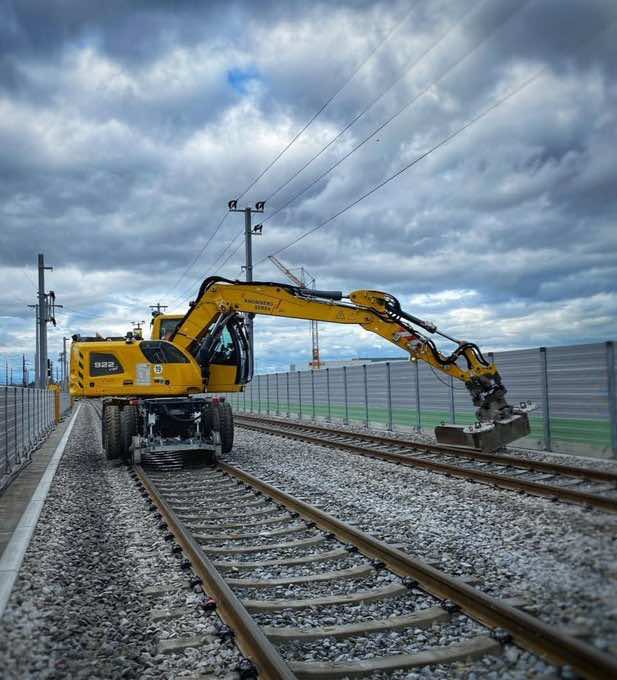
Ballast Renewal: When ballast is damaged beyond re-use, complete renewal becomes necessary. One method involves dumping fresh ballast on the track, jacking the entire track above it, and tamping it down. Alternatively, undercutters can remove ballast from beneath the track without lifting it.
Pneumatic Ballast Injection (Stoneblowing): A more modern technique lifts the rails and ties and forces smaller stones into gaps to level the track, disturbing less of the well-compacted ballast than traditional tamping.
After maintenance activities, speed limits are often temporarily reduced to allow fresh or disturbed ballast to properly settle and consolidate under traffic.
Ballastless Track: The Alternative Approach
While this article focuses on ballasted track systems, it's important to note that not all railway tracks use ballast. Ballastless track designs, increasingly common in urban transit systems and some high-speed railways, embed rails directly in concrete slabs.
Ballastless track offers advantages including reduced maintenance requirements, longer service life in certain applications, and elimination of ballast-related track geometry issues. However, these systems sacrifice the flexibility, drainage, and ease of adjustment that characterize ballasted track, making them less suitable for many applications.
Traditional ballasted track continues to dominate railway construction globally due to its proven reliability, relatively low initial cost, ease of maintenance, and adaptability to varying ground conditions.
The Engineering Behind Ballast Profiles
The cross-sectional design of ballast follows specific engineering principles to optimize performance.
Ballast Profile: The ballast extends beyond the track width on both sides, forming shoulders that provide lateral support. Standard profiles are precisely calculated to balance drainage requirements against material stability.
Slope Design: The ballast surface is sloped away from the track center, facilitating water runoff while maintaining structural stability. Typical slope ratios range from 1.5:1 to 3:1 (horizontal to vertical).
Width Requirements: For Indian broad gauge track, the ballast width is 3.35 meters; for meter gauge track, it's 2.3 meters. These widths ensure adequate shoulder formation beyond the sleeper ends.
Historical Evolution of Ballast Use
The use of ballast in railway construction has evolved significantly since the earliest railways. Although good-quality hard angular stone of nominal size 40-50mm is now universally accepted as the best material for ballast, historically track has existed longer on non-stone ballast than on stone ballast.
Even stone ballast specified until the 1980s featured smaller average particle sizes than current specifications. This evolution reflects improved understanding of ballast mechanics and the demands of heavier, faster trains on modern railway systems.
The development of British Rail ballast specifications, for instance, shows a clear progression toward larger, more uniform particle sizes and stricter quality controls as rail technology advanced and train speeds increased.
Quantity Requirements
The amount of ballast required varies by track gauge and application:
For Indian railways, the quality of stone ballast required per meter of tangent (straight) track for broad gauge is 1.11 cubic meters, while meter gauge requires 0.767 cubic meters per meter of track length.
These quantities account for the ballast beneath sleepers, between sleepers, and forming the essential shoulders on both sides of the track.
Environmental and Economic Considerations
Sustainability Factors
Modern railway operators increasingly consider environmental factors in ballast sourcing and use:
- Local Sourcing: Using locally available stone meeting quality requirements reduces transportation costs and environmental impact
- Recycling: Cleaned ballast can be reused multiple times before requiring replacement
- Quarry Impact: Ballast production requires extensive quarrying operations, with associated environmental considerations
- Lifecycle Assessment: The long service life of quality ballast (20-30 years or more with proper maintenance) offsets its initial resource consumption
Economic Aspects
While crushed stone ballast has a higher initial cost than some alternatives, it proves economical in the long run through:
- Reduced maintenance frequency compared to inferior materials
- Longer service life when properly maintained
- Lower lifecycle costs despite higher upfront material expenses
- Improved safety and reduced risk of costly derailments or service disruptions
Conclusion: The Indispensable Foundation of Rail Transport
The crushed stones beneath railway tracks represent far more than simple packing material—they constitute a sophisticated engineering system carefully designed to ensure railway safety, stability, and operational efficiency.
From distributing enormous train loads across weak soil formations, to providing drainage that prevents track degradation, to maintaining precise track geometry through thermal expansion and ground movement, railway ballast performs multiple simultaneous functions that no other single system can effectively replace.
The angular shape of crushed stone proves critical to this performance, creating the mechanical interlocking that prevents track movement while maintaining drainage voids. This specific geometry explains why naturally rounded stones cannot substitute for properly crushed ballast material.
Modern railway ballast specifications reflect centuries of operational experience and decades of engineering research, resulting in precise requirements for particle size, shape, gradation, and physical properties. These specifications ensure that ballast performs reliably under the extreme conditions of modern railway operation—supporting trains that exert 100 psi or more on the track structure while traveling at speeds exceeding 300 km/h on high-speed lines.
As railway technology continues to advance, with heavier freight trains and faster passenger services, the importance of properly specified and maintained ballast only increases. While ballastless track designs offer advantages in specific applications, traditional ballasted track remains the foundation of global railway infrastructure, testament to the fundamental engineering principles embodied in those seemingly simple crushed stones.
The next time you see a railway track, take a moment to appreciate the sophisticated engineering beneath those rails—an elegant solution to the complex challenge of creating stable, durable pathways for one of humanity's most efficient transportation systems. Those crushed stones, carefully selected for their angular shape and arranged in precise layers and profiles, literally keep the trains running safely on time.




Comments
Post a Comment